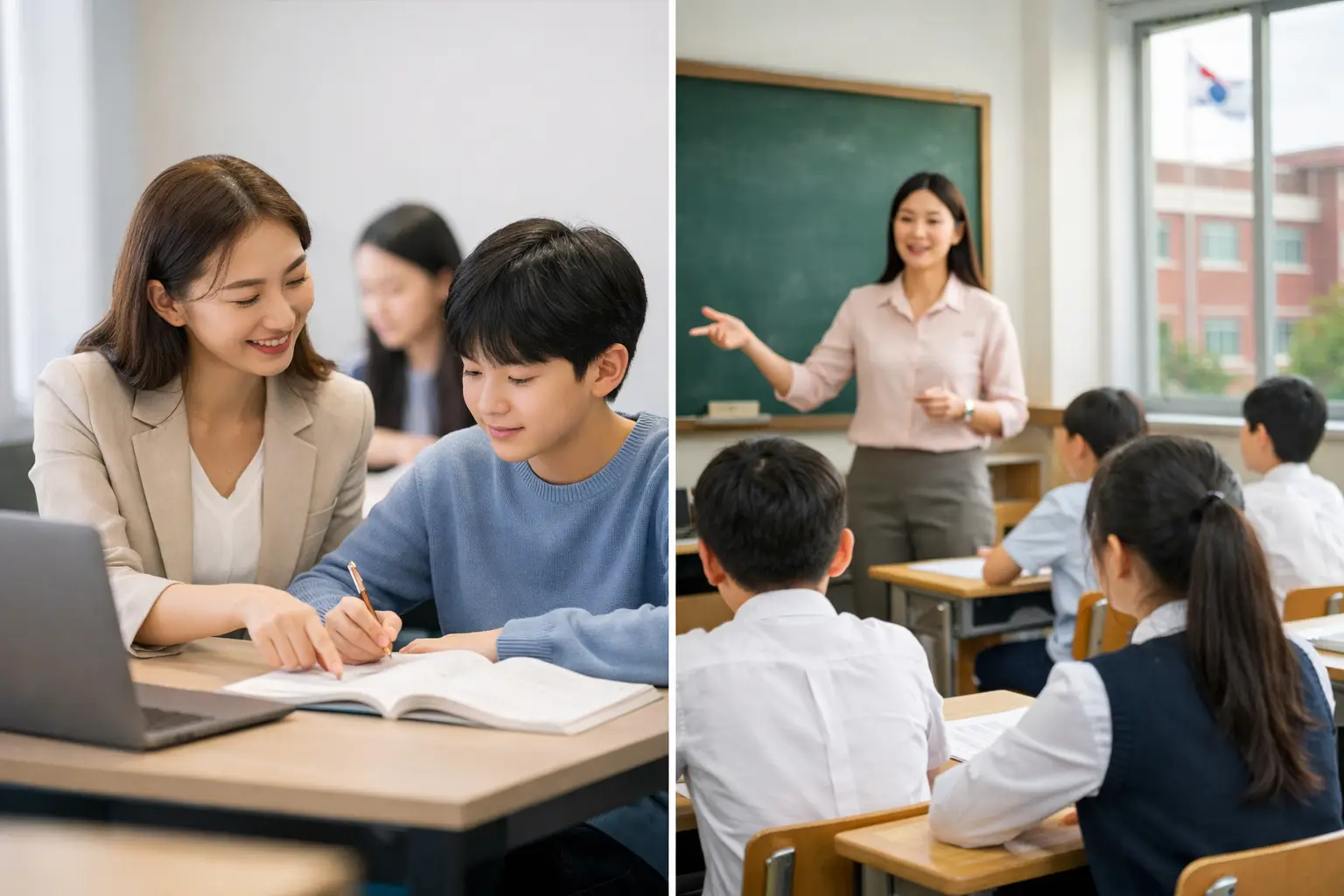
If you are comparing hagwon vs public school Korea jobs, you are already asking the right question. The biggest mistakes teachers make in Korea usually happen before they land – when they accept a role based on salary alone, assume all schools operate the same way, or overlook how a contract will affect daily life. In Korea, your workplace shapes your schedule, energy level, support system, and even how quickly you settle into the country.
For most first-time teachers, the choice comes down to two main paths. You can work at a public school, usually through a regional office of education or a government-backed program, or you can work at a hagwon, which is a private academy. Both can be solid options. Both can also be frustrating if the role is not a good match for your personality, teaching style, or expectations.
Hagwon vs public school Korea: what is the real difference?
A public school job places you in the regular Korean school system. You are usually teaching kindergarten through middle or high school students during standard school-day hours. Your contract tends to be more standardized, and the pace is often shaped by the academic calendar and government rules.
A hagwon job places you in the private after-school academy market. Hagwons serve students outside regular school hours, which means many positions run later in the day. Some focus on kindergarten and elementary students in the morning and early afternoon, while others focus on elementary, middle, or high school students in the afternoon and evening. The structure, expectations, and management style can vary a lot from one academy to another.
That variation is the biggest point to understand. Public school jobs are usually more predictable across the board. Hagwon jobs can differ sharply depending on ownership, branch size, curriculum, and management.
Schedule and workload
For many teachers, this is the deciding factor.
Public school positions usually follow a daytime schedule, often Monday through Friday. You may be at school from morning until late afternoon, even if your actual classroom teaching hours are lower than that. Desk warming – being required to stay at school during non-teaching periods or school breaks – is common in some placements. That can feel inefficient, but some teachers like the structure and use that time for lesson planning, studying Korean, or simply adjusting to school life.
Hagwon schedules often start later, which appeals to people who are not morning people. A typical academy role might begin in the afternoon and end in the evening. Kindergarten hagwons can start much earlier and feel more like a full-day elementary program. The teaching load in hagwons is often more concentrated, with back-to-back classes and less downtime between them.
If you want evenings free, public school is usually the better fit. If you want slower mornings and do not mind finishing later, a hagwon may suit you better.
Pay, benefits, and what the salary really means
On paper, hagwons sometimes offer slightly higher starting salaries than public schools. That gets attention quickly, especially for first-time teachers budgeting for student loans, savings goals, or travel.
But salary should never be read in isolation. Public school jobs often come with clearer benefit structures, more regulated working conditions, and better vacation time. Hagwon contracts may advertise stronger monthly pay, but the trade-off can be longer teaching hours, fewer vacation days, or stricter expectations around prep, events, or parent communication.
Housing, airfare support, severance, pension, and health insurance matter just as much as base salary. In a good contract, those pieces are clearly stated. In a weak contract, the wording may be vague enough to create problems later.
This is where careful screening matters. A slightly lower salary at a reputable school can leave you in a much stronger position than a higher-paying job with unstable management or unclear expectations.
Vacation and time off
This is one area where public school jobs often stand out.
Public school teachers generally receive more vacation days, although exact use of those days depends on the school calendar and office of education policies. National holidays are usually straightforward, and the yearly structure tends to be easier to anticipate.
Hagwon vacation is often shorter. Some academies offer a set number of days in summer and winter, and the dates may not be flexible. Others handle leave more generously, but that is not something to assume. In private academies, scheduling is tied closely to student enrollment and business needs.
If travel time, family visits, or a more traditional holiday structure matter a lot to you, public school usually has the advantage.
Classroom environment and teaching style
Public school classrooms often involve larger groups, mixed ability levels, and co-teaching with a Korean teacher, especially in elementary settings. Some teachers appreciate the support of having a co-teacher and a more formal school environment. Others find co-teaching inconsistent, depending on how involved the Korean staff member is and how clearly roles are defined.
Hagwons usually run smaller classes, and they tend to focus more heavily on speaking, test prep, phonics, or conversation goals depending on the academy type. You may have more direct control over your classroom, but also more pressure to deliver visible results to students and parents.
Neither system is automatically easier. Public school can be less intense minute-to-minute but harder to personalize. Hagwon teaching can feel more dynamic and relationship-driven, but the pace is often faster and parent expectations can be higher.
Support, training, and management
This is where good placements matter more than job category.
Public schools tend to operate within a larger administrative system. That can be reassuring because there are usually established procedures, but it can also mean slower communication and more bureaucracy. If you are someone who likes formal systems and clear reporting lines, that may feel comfortable.
At a hagwon, management quality depends heavily on the school owner or director. A well-run hagwon can be organized, supportive, and teacher-friendly. A poorly run one can be stressful fast. Because hagwons are private businesses, leadership style has a bigger day-to-day effect on your experience.
That is why approved, well-vetted schools matter so much. A contract can look fine at first glance, but school culture, staff turnover, and communication standards tell you far more about what life on the ground will be like.
Which option is better for first-time teachers?
There is no universal answer, but there are patterns.
Public school is often a strong starting point for teachers who want a more traditional weekday schedule, more vacation, and a role that feels institutionally stable. It can be a good fit if you are nervous about relocating, want a gentler introduction to Korea, or prefer a school environment with clearer public oversight.
Hagwons can be a very good fit for teachers who want a livelier classroom pace, a later daily start, or a location in a major city where private academies are more common. They can also suit candidates who enjoy working closely with younger learners or prefer a private-sector environment.
The real question is less which one is better and more which one matches your working style.
How to evaluate a hagwon or public school offer in Korea
When reviewing any offer, focus on the details that affect your actual week, not just the headline salary. Ask how many teaching hours are required, what the full workday looks like, whether lesson planning is built into the schedule, and how vacation is assigned. Confirm housing arrangements, overtime rules, and who helps with visa steps and arrival logistics.
For hagwon roles, ask about staff turnover, curriculum, class size, and whether there are weekend events or marketing duties. For public school roles, ask whether you will have one school or multiple campuses, whether you are expected to desk warm during breaks, and how co-teaching works at that placement.
A trustworthy recruiter should be able to help you read between the lines, compare contract terms realistically, and steer you away from schools with warning signs. That kind of support matters even more if this is your first move abroad.
Hagwon vs public school Korea: how to choose with confidence
If your priority is stability, daytime hours, and better vacation, public school often makes sense. If your priority is a potentially higher salary, later starts, and a more private-school pace, a hagwon may be the better fit.
What matters most is choosing a school that is reputable, transparent, and prepared to support a foreign teacher properly. The best job in Korea is not the one that sounds best in a short listing. It is the one that matches your goals, gives you a workable contract, and sets you up to live well once you arrive.
A smart move is to think beyond the first paycheck and picture your ordinary Tuesday. If the schedule, support, and school culture make sense there, you are probably looking in the right direction.